Haemorrhage or risk of haemorrhage in increased fibrinolysis or fibrinogenolysis that may occur in conditions:
- Prostatectomy and bladder surgery
- Menorrhagia
- Epistaxis
- Conisation of the cervix
- Management of dental extraction in patients with coagulopathies
- Ulcerative colitis
- Haematuria
- Gastrointestinal haemorrhage
General fibrinolysis as in prostatic and pancreatic cancer, after thoracic and other major surgery, in obstetrical complications such as abruptio placentae and post- partum haemorrhage, in leukaemia and liver diseases and in connection with thrombolytic therapy with streptokinase.
Hereditary angioneurotic oedema.
Anti-fibrinolytic drugs, Haemostatic drugs
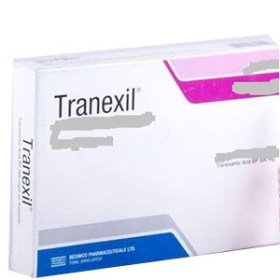
PHARMACOLOGICAL ACTIONS: Tranexamic acid has a strong inhibitory effect on the activation of plasminogen, i.e. the conversion of plasminogen to plasmin, in the fibrinolytic system.The half life is 1-2 hours. Plasma protein binding is 3% at therapeutic plasma levels. The plasma protein binding seems fully accounted by its binding to plasminogen. Tranexamic acid is excreted unchanged in the urine.PHARMACOKINETICS: Tranexamic acid is rapidly absorbed from the gastrointestinal tract. Maximum serum levels are reached within 2-3 hours. After oral administration, about 40% of the dose is excreted in the urine during the first 24 hours. After intravenous administration 45% of the dose is excreted in the urine during the first day.
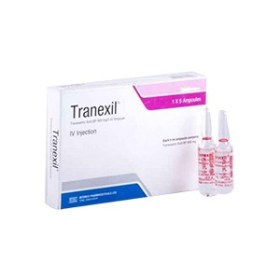
Intravenous administration is necessary only if it is difficult to give adequate doses by mouth. The recommended standard dose is 1 to 1.5 gm or 5-10 ml by slow intravenous injection at a rate of 1 ml/minute, two to three times daily. For the indications listed below the following doses are recommended.
PROSTATECTOMY: 5-10 ml by slow intravenous injection every eight hours (the first injection being given during the operation) for the first three days after surgery; thereafter 1-1.5 gm orally three to four times daily until macroscopic haematuria is no longer present.
MENORRHAGIA: 1-1.5 gm orally three to four times daily for three to four days.
EPISTAXIS: 1.5 gm orally three times daily for four to ten days. Tranexamic Acid injection may be applied topically to the nasal mucosa of patients suffering from epistaxis. This can be done by soaking a gauze strip in the solution, and then packing the nasal cavity.
HAEMATURIA: 1-1.5 gm orally 2-3 times daily until macroscopic haematuria is no longer present.
CONISATION OF THE CERVIX: 1.5 gm orally 3 times a day for 12 to 14 days post-operatively.
DENTAL SURGERY IN PATIENTS WITH COAGULOPATHIES: Immediately before surgery, 10 mg per kg body-weight should be given intravenously. After surgery, 25 mg per kg body-weight are given orally three to four times daily for six to eight days. Coagulation factor concentrate might be necessary to administrate.
GENERAL FIBRINOLYSIS: 1 gm by slow intravenous injection three to four times daily. With fibrinolysis in conjunction with diagnosed, increased intravascular coagulation i.e. defibrillation syndrome, an anticoagulant such as heparin may be given with caution.
HEREDITARY ANGIONEUROTIC OEDEMA: 1-1.5 gm orally two to three times daily as intermittent or continuous treatment depending on whether the patient has prodromal symptoms or not.
CHILDREN:
- Oral dose: 25 mg/kg 2 to 3 times daily for 7 to 10 days.
- Injection: 10 mg/kg 6 to 8 hours for 7 to 10 days
Clinically important interactions have not been observed with Tranexamic acid. Because of the absence of interaction studies, simultaneous treatment with anticoagulants must take place under the strict supervision of a physician experienced in this field.
- Active thromboembolic disease, such as deep vein thrombosis, pulmonary embolism and cerebral thrombosis
- Subarachnoid haemorrhage
- Hypersensitivity to Tranexamic acid or any of the ingredients
Dose-dependent, gastrointestinal discomfort is the most commonly reported undesirable effect, but it is usually of mild and temporary in nature. Allergic skin reactions have been reported as an uncommon undesirable effect. Hypotension may occur after fast injection.
Pregnancy: Tranexamic acid crosses the placenta. Clinical experience of use in pregnant women is limited. Animal studies have not supplied any evidence of an increased incidence of fetal damage.Lactation: Tranexamic acid is excreted into breast milk, but it is not likely to influence the child at therapeutic doses.



Reviews
There are no reviews yet.